











Shopping Cart
There are no more items in your cart
- Updated
- José María Navas Humanes
- Work out
TL;DR: protein is the material the body uses to build and repair muscle, bones, skin and organs, and to make enzymes and hormones. A sedentary adult needs 0.8 g per kilo of body weight a day; people who strength train use 1.6 to 2.2 g per kilo. Protein powder, at 22 to 24 g per serving, is a convenient way to reach that amount, not a requirement. In healthy people there is no solid evidence that it harms the kidneys.
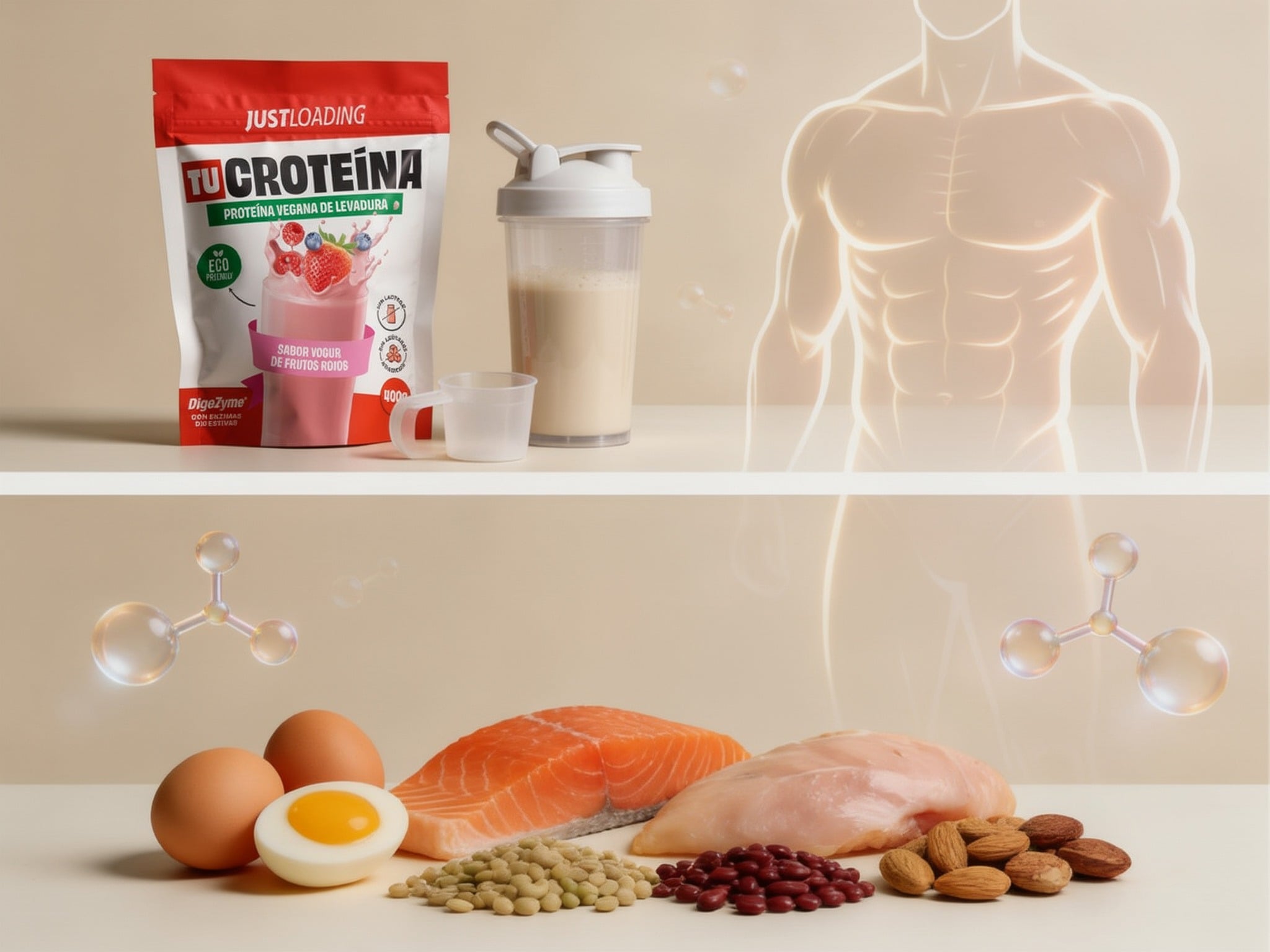
When people talk about protein, the image that comes to mind is a shake after training. Protein does far more than that, and someone who never sets foot in a gym needs it just the same. Here is what it is for, what it does in the body, how much you need and when taking it as a powder makes sense.
What protein does in the body
What is protein for?
Protein is the material the body uses to build and repair muscle, bones, skin and organs, and to make enzymes and hormones. It also carries oxygen and other substances in the blood. It contributes to the growth and maintenance of muscle mass and to the maintenance of normal bones.
What does protein do in the body?
Your digestive system breaks it into amino acids and the body uses them as building pieces: it repairs muscle fibres, makes enzymes that speed up chemical reactions, hormones such as insulin, proteins that carry oxygen, like haemoglobin, and others that balance fluids, like albumin.
Imagine the body as a house under permanent construction. Protein is the bricks, and amino acids are the pieces they are made of.
Structural functions
Muscle is the best known: when you train, the fibres suffer tiny tears and the amino acids from protein are used to repair them. Collagen, the most abundant protein in the body, is part of skin, tendons, ligaments and cartilage. Organs such as the heart, liver and kidneys are largely made of protein, and every tissue needs a steady supply to renew itself.
Metabolic functions
Many enzymes, the ones that start the chemical reactions of digestion or energy production, are proteins. So are hormones such as insulin, which regulates blood sugar. The haemoglobin in red blood cells carries oxygen from the lungs to the rest of the body, and the albumin in the blood helps keep fluids balanced inside and outside cells.
What protein is for in the gym
If you train, protein is the raw material for what you want to achieve. To choose products for your goal, there is the product guide by goal.

What is protein for in the gym?
With strength training as the stimulus, it supplies the amino acids to repair the fibres damaged in each session and to build new muscle. Without the stimulus of exercise there is no gain, and without enough protein the stimulus yields less. Protein contributes to the growth and maintenance of muscle mass.
Recovery after training
After the session, damaged fibres need amino acids to repair themselves, and protein supplies them. There is no basis to promise that it removes soreness or shortens rest, but without enough protein the muscle has less material to repair itself with. More on the subject in the article on muscle recovery.
Protein and creatine
They are often taken together because they do different things: creatine helps in short, intense sets and protein repairs and builds. The questions about that combination are in creatine vs protein, and a broader view is in supplements for building muscle mass.
Protein and weight
Protein is not only for athletes. It also matters if you want to manage your weight, because what counts is the total calories of each day.
Does protein make you fat?
No food makes you fat on its own: what counts is the day's calorie balance. Protein provides about 4 kcal per gram, the same as carbohydrate and less than half as much as fat (9 kcal). If you exceed your total calories, the surplus is stored as fat, wherever it comes from.
Including a protein source at every meal is a simple way to spread the day's grams. If you want to add protein without losing muscle while you adjust your calories, the article on losing weight without losing muscle covers it, and protein bars make a handy snack.
What happens if I take protein and do not exercise?
It does not turn into muscle by itself, because that needs the stimulus of training. The body still uses it to repair tissue and make hormones and enzymes. Surplus calories, from protein or anything else, can be stored as fat, so match your total intake to your activity.
Protein powder: what it is for and which types exist
What is protein powder for?
It tops up the protein in your diet when food alone does not get you there, conveniently and in a measured amount. A serving of whey provides between 22 and 24 g of protein. It does not beat protein from food and works for adding grams before or after training or between meals.
Timing matters less than your total for the day. A shake after training is convenient and makes sense, but it works just as well between meals or at breakfast if food alone does not get you to your amount. If you already reach your grams with food, the powder adds nothing you do not already have.
Whey, hydrolysed, plant-based and yeast
Whey, or milk serum protein, has a complete profile of essential amino acids and is absorbed quickly. The 400 g chocolate whey provides 22.4 g of protein per serving and 1.4 g of carbohydrate; the vanilla one, 23.4 g per serving, with 14 shakes per pack. The whey with creatine in biscuit flavour gives 15.3 g of protein and 3 g of creatine per serving, in a single mix.
Hydrolysed protein has been treated with enzymes that break the amino acid chains into smaller fragments, so it is digested more easily. It may suit people with a sensitive digestion.
Vegetarian and vegan diets can use soya, pea, rice and hemp protein, and combining several through the day covers the amino acid profile. Yeast protein, obtained from Saccharomyces cerevisiae, is another vegan option: the red berries one provides 19.5 g of protein, 3.2 g of carbohydrate and 110 kcal per serving. And if you want something with no preparation, the ready-to-drink protein shake has 20 g of protein per unit and no lactose. For protein from real food rather than powders, see high-protein foods.
How much protein you need
How much protein do I need a day?
The general recommendation for a sedentary adult is 0.8 g per kilo of body weight. People who strength train or want to build muscle use between 1.6 and 2.2 g per kilo. At 70 kg, that is about 56 g a day in the first case and 112 to 154 g in the second.
How to spread it and where to get it
Spreading protein across the day's meals is practical. At 70 kg and 1.6 g per kilo you get about 112 g, which over four servings is 28 g each: a breakfast with eggs or yoghurt, a lunch with meat, fish or pulses, a snack and a dinner. Complete proteins, such as egg, dairy, meat, fish and soya, supply all the essential amino acids. Other plant proteins are combined through the day, for example pulses with cereals.
Over 40 and sarcopenia
With age, muscle mass is lost naturally, a process called sarcopenia, which reduces strength and raises the risk of falls. Keeping up enough protein and doing strength exercise helps preserve muscle mass. More in supplements after 40.
Does too much protein damage the kidneys?
In healthy people with normal kidney function there is no solid evidence that a high-protein diet damages the kidneys. The worry comes from the advice to limit it for people who already have kidney disease. If that is you, talk to your doctor before raising your protein or taking supplements.
References
- International Society of Sports Nutrition Position Stand: protein and exercise. Jäger R et al., J Int Soc Sports Nutr, 2017
- A systematic review, meta-analysis and meta-regression of the effect of protein supplementation on resistance training-induced gains in muscle mass and strength in healthy adults. Morton RW et al., Br J Sports Med, 2018
- Scientific Opinion on Dietary Reference Values for protein. EFSA Journal, 2012
- Changes in Kidney Function Do Not Differ between Healthy Adults Consuming Higher- Compared with Lower- or Normal-Protein Diets: A Systematic Review and Meta-Analysis. Devries MC et al., J Nutr, 2018
