











Shopping Cart
There are no more items in your cart
In short: sarcopenia is the age-related loss of muscle mass and strength, and the European EWGSOP2 consensus (Cruz-Jentoft et al., Age and Ageing, 2019) classifies it as a disease. From around age 50 you lose roughly 0.5 to 1 per cent of muscle mass a year, with strength falling faster than size. The two levers with the strongest evidence are resistance training and eating enough protein: 1.0 to 1.2 grams per kilo of body weight per day in healthy older adults, and 1.2 to 1.5 if illness is present, per the PROT-AGE position paper (Bauer et al., 2013) and the ESPEN Expert Group recommendations (Deutz et al., 2014). For a 70 kg person that is 70 to 84 grams a day, which fits into two eggs, a large Greek yoghurt, a chicken breast and a plate of lentils.
Medical notice: this article is nutrition and training information, not a diagnosis or a treatment. Sarcopenia is a medical condition that a healthcare professional assesses and treats. If you notice loss of strength, falls, unusual fatigue or unexplained weight loss, speak to your doctor or a registered dietitian before changing how you eat or starting to train. Nothing here replaces that consultation.
What sarcopenia is, and why it comes up at 50
There is a sentence that gets repeated in clinics and at family dinners: «it's just age». People say it when getting off the sofa takes effort, when the shopping feels heavier than it did five years ago, when someone reaches for a handrail they used to ignore. The sentence describes something real, but it describes it badly, because it implies there is nothing to be done.
What sits underneath has a proper name and a good deal of science behind it.
What is sarcopenia?
Sarcopenia is a progressive and generalised skeletal muscle disorder. That is the wording of the EWGSOP2 European consensus, published by Cruz-Jentoft and colleagues in Age and Ageing in 2019, which treats it as a disease rather than an unavoidable part of growing older.
Classifying it as a disease changes how it is approached. The EWGSOP2 paper sets out a four-step pathway: find, assess, confirm and grade severity. It starts with a short five-item questionnaire, SARC-F, asking about strength, walking, rising from a chair, climbing stairs and falls. No laboratory test, no equipment.
At what age does muscle loss start?
Muscle mass starts to fall measurably from around age 50, at roughly 0.5 to 1 per cent a year, according to the quantitative review by Mitchell and colleagues in Frontiers in Physiology in 2012. Strength is lost earlier and faster than size.
The second half of that finding matters most: strength deteriorates faster than volume. That is why someone can look much the same in the mirror and still struggle to open a jar or lift a grandchild. The mirror measures size; daily life measures strength.
How do you know if you have sarcopenia?
Diagnosis belongs to a healthcare professional, not to a website. The EWGSOP2 consensus uses handgrip strength, with cut-off points of 27 kg in men and 16 kg in women, plus a chair stand test where rising five times from a chair takes longer than 15 seconds. Muscle quantity is then confirmed by scan.
Those EWGSOP2 cut-off points deserve a careful read. They are not a home test: grip strength is measured with a calibrated dynamometer, and the chair stand test has a protocol. If you read it and think «I take longer than fifteen seconds», that is not a diagnosis, it is a sensible reason to book an appointment. Confirmation involves measuring muscle quantity by DXA or bioimpedance, and severity is graded with physical performance tests such as gait speed.
Why the body gives up muscle over the years
Muscle is under permanent renovation: protein is built and broken down every day. With age that balance tips toward breakdown for several reasons at once, and none of them acts alone.
The first is the response to food. Moore and colleagues published a regression analysis in The Journals of Gerontology in 2015 comparing protein doses in young and older adults: to maximally stimulate muscle protein synthesis, older adults needed a larger relative dose per meal than younger ones. The same omelette does less work at 70 than at 30.
The second is use. Muscle that receives no load adapts downward, and that adaptation is quick. A hospital stay, a convalescence or a sedentary winter all leave a mark, and past a certain age that mark is harder to erase.
What causes sarcopenia?
Ageing itself drives part of it, but the modifiable factor that weighs most is removing load from the muscle. Inactivity and prolonged bed rest speed the loss, and resistance training is the intervention with the strongest evidence base in this population.
There is a third factor that gets less attention and carries a lot of weight: simply eating less. When appetite drops, and it does drop with age, protein tends to be the first thing to leave the plate, because meat, fish and pulses are more filling and take more chewing and more cooking than toast or a piece of fruit.
What diseases cause muscle loss?
The EWGSOP2 consensus describes secondary sarcopenia, which is linked to systemic inflammatory disease, to cancer, to advanced organ failure and to inadequate energy or protein intake. If muscle loss is rapid or cannot be explained, seeing a doctor comes first, before changing anything about diet or training.
That distinction between primary sarcopenia, tied to age alone, and secondary sarcopenia, which accompanies something else, is why this article cannot be your only source. If muscle is going quickly, the reason needs finding before anything gets bought.
How much protein you need from 50 onwards
Here is the number almost nobody has clear, and the reason almost nobody has it clear is that two different numbers are in circulation.
The first is the reference intake for the general adult population: 0.83 grams of protein per kilo of body weight per day. That figure is calculated to cover the maintenance needs of a healthy adult, and it works well as a safety floor.
The second comes from the groups that study ageing specifically. The PROT-AGE position paper, coordinated by Bauer and published in the Journal of the American Medical Directors Association in 2013, and the ESPEN Expert Group recommendations, authored by Deutz and published in Clinical Nutrition in 2014, both raise that floor for older adults. Both are consensus documents rather than clinical trials, and that is worth saying plainly: they reflect what an expert panel concludes from the available evidence.
How much protein do seniors need a day?
The PROT-AGE position paper by Bauer and colleagues in 2013 recommends 1.0 to 1.2 grams of protein per kilo of body weight per day for healthy older adults, and 1.2 to 1.5 grams when acute or chronic illness is present. ESPEN's recommendations agree.
The table below turns those ranges into concrete grams and concrete food. The last column is not a full day's menu: it lists the protein-rich portions that, added together, cover the healthy 65-and-over band. The rest of the day (bread, vegetables, fruit, oil) adds more and is not counted here.
| Body weight | Up to age 65 (0.83 g/kg) |
65 and over, in good health (1.0-1.2 g/kg) |
65 and over, with acute or chronic illness (1.2-1.5 g/kg) |
A day of meals that covers the healthy 65+ range |
|---|---|---|---|---|
| 55 kg | 45.6 g | 55-66 g | 66-82.5 g | 2 eggs + 200 g Greek yoghurt + 100 g hake + 100 g cooked lentils = 57 g |
| 60 kg | 49.8 g | 60-72 g | 72-90 g | 2 eggs + 200 g Greek yoghurt + 120 g hake + 120 g cooked lentils = 62.2 g |
| 65 kg | 53.9 g | 65-78 g | 78-97.5 g | 2 eggs + 200 g Greek yoghurt + 150 g chicken breast + 100 g cooked lentils = 73 g |
| 70 kg | 58.1 g | 70-84 g | 84-105 g | 2 eggs + 250 g Greek yoghurt + 150 g chicken breast + 100 g cooked lentils = 77.5 g |
| 75 kg | 62.2 g | 75-90 g | 90-112.5 g | 3 eggs + 250 g Greek yoghurt + 150 g chicken breast + 120 g cooked lentils = 85.8 g |
| 80 kg | 66.4 g | 80-96 g | 96-120 g | 3 eggs + 250 g Greek yoghurt + 180 g chicken breast + 120 g cooked lentils = 92.4 g |
| 90 kg | 74.7 g | 90-108 g | 108-135 g | 3 eggs + 300 g Greek yoghurt + 200 g chicken breast + 150 g cooked lentils = 104 g |
Two quick readings of that table. First: the gap between the up-to-65 column and the 65-and-over one is not enormous in absolute terms, roughly 12 to 25 grams depending on weight, and those 12 to 25 grams fit into a Greek yoghurt and an egg. Second: the higher ranges, the illness column, are no longer a home-kitchen matter and should be set in consultation.
What is the best protein for seniors?
The one that actually gets eaten every day. Neither PROT-AGE nor ESPEN singles out one source as superior: what they recommend is spreading the daily total across main meals, because older adults need a larger dose per meal to get the same response.
On distribution it pays to be specific. If you need 80 grams and take 10 at breakfast, 20 at lunch and 50 at dinner, you have hit the total but left two meals below the threshold that stimulates muscle protein synthesis properly. Splitting it 25, 30 and 25 makes better use of the same amount. It is the cheapest change on this list, because it costs no money, only organisation.
Now the legal part, which in food is not decoration. In the European Union, only the health claims authorised in Regulation (EU) No 432/2012 may be attributed to a food, and only in their official wording. For protein, the authorised claims include these two:
- «Protein contributes to the maintenance of muscle mass.»
- «Protein contributes to the maintenance of normal bones.»
The condition of use is written into the regulation itself: «The claim may be used only for food which is at least a source of protein as referred to in the claim SOURCE OF PROTEIN as listed in the Annex to Regulation (EC) No 1924/2006». And that Annex defines a source of protein as a food where at least 12 % of the energy value is provided by protein. A plain Greek yoghurt qualifies. A soft drink with two grams of added protein does not.
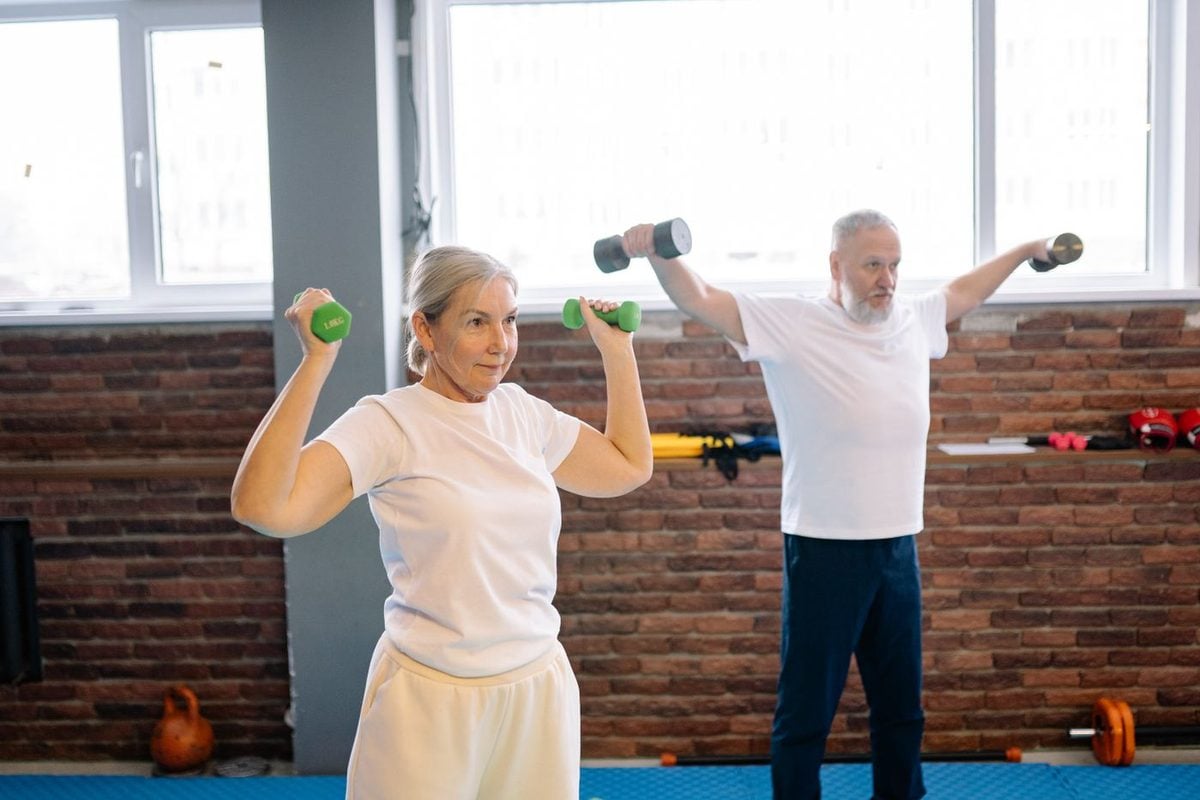
Resistance training, the part you cannot buy
If you keep one thing from this article, keep this: protein is the material, but the signal to build comes from training. Without that signal, the material gets used for something else.
How do you build muscle after 60?
With structured resistance training and enough protein, and under medical supervision if sarcopenia has already been diagnosed. The meta-analysis by Peterson and colleagues in Ageing Research Reviews in 2010 found consistent strength gains in older adults who trained with resistance.
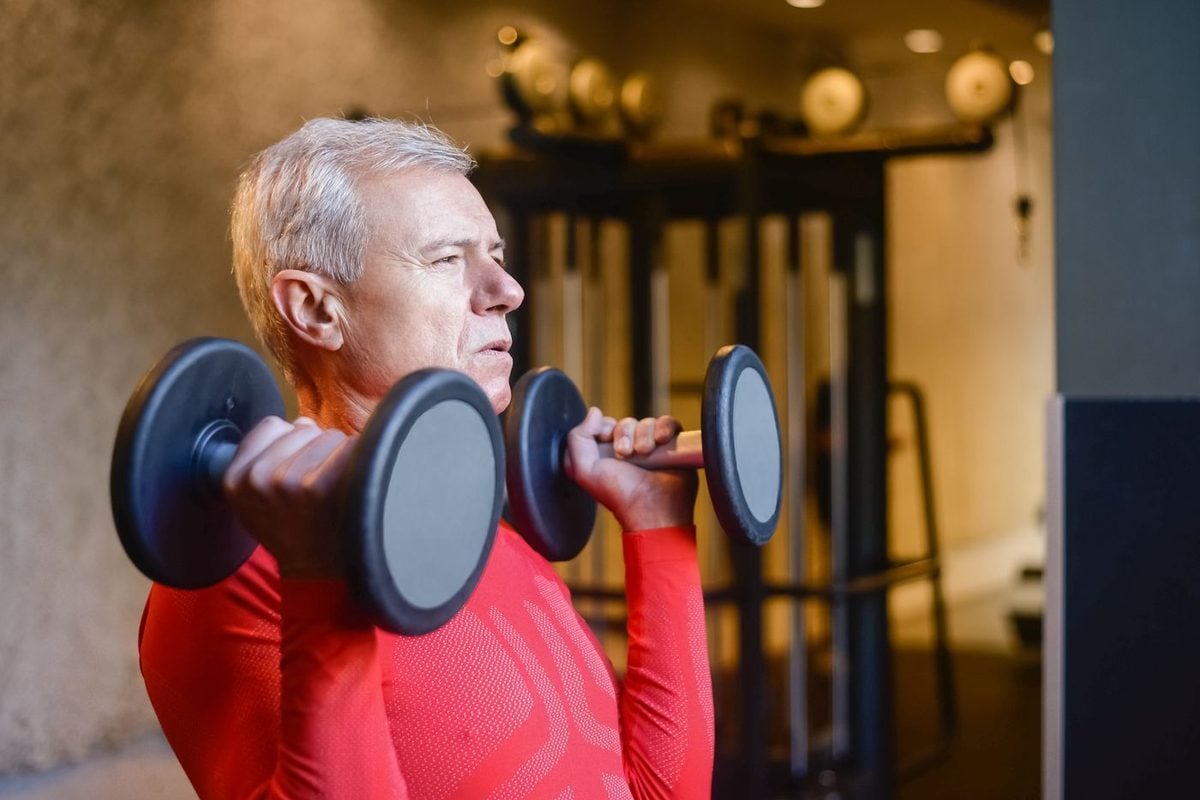
That meta-analysis pooled resistance training studies in older adults and found consistent strength improvements. It is worth being clear about what «resistance» means here, since the word misleads: it is not about endurance, it is about working against a load. Dumbbells, bands, machines, your own body weight or a water container all count.
What exercises help with sarcopenia?
The ones that make the muscle work against a load. The World Health Organization advises adults over 65 to do muscle-strengthening work on at least two days a week, plus multicomponent training including balance and strength on three or more days a week.
The World Health Organization's 2020 guidelines, published by Bull and colleagues in the British Journal of Sports Medicine, put numbers on the whole week: 150 to 300 minutes of moderate-intensity aerobic activity, muscle-strengthening work covering all major muscle groups on at least two days, and for adults over 65 multicomponent training including balance and strength on three or more days a week. The balance part is not decorative filler: it is there because of falls.
On getting started, three things that commonly go wrong:
- Starting too light and staying there. The stimulus has to rise over time or the body stops responding.
- Training only legs or only arms. All the major muscle groups get their turn.
- Confusing «I got tired» with «I trained for strength». An hour's walk is excellent and does not count as strengthening.
- Skipping the written record. Noting the weight and repetitions of each session is what turns three months of gym into a plan.
Fitting all this into an ordinary week
The above is fine in theory and collapses in week one unless it translates into something that fits a real day, with its timetable, its budget and its energy levels.
A simple way to organise it is to fix breakfasts first, because that is the meal where most people fall shortest on protein. Toast with oil and a coffee comes to about 6 grams. Adding two scrambled eggs or a large Greek yoghurt takes it to 19 or 24 grams without moving house or changing your schedule. That single change already covers much of the difference between the two age columns in the table above.
Then come evening meals, where protein tends to get cut back «to sleep better». A dinner of vegetable soup and fruit lands at 4 or 5 grams. The same soup with a tin of tuna in water or some sautéed tofu goes up to 17 or 18.
And in between there are the days with no time to cook, which exist and are many. That is where a shake, a high-protein yoghurt or a bar do their job, which is to plug a gap rather than to be the foundation of anything.
If you want to see where the grams in each food come from, we keep a longer list in our guide to supplements for building muscle mass, with the usual portion sizes for each.
Creatine after 50: the evidence and what the law allows you to say
Creatine is probably the most studied supplement on the sports market, and in recent years it has left the gym and entered the conversation about ageing. Three things get mixed together here and need separating carefully: what the studies say, what European law allows a product to claim, and what a product in our own catalogue can specifically claim.
Does creatine work for seniors?
The 2017 meta-analysis by Chilibeck and colleagues, covering 22 studies and 721 participants, found 1.37 kg more lean tissue mass in people taking creatine while resistance training, compared with placebo. Without the training underneath it, that effect does not hold.
That meta-analysis, published in the Open Access Journal of Sports Medicine, pooled 22 studies with 721 participants whose mean ages ranged from 57 to 70. The difference against placebo was 1.37 kg of lean tissue mass, with improvements in chest press and leg press strength as well. A year earlier, Devries and Phillips had published a meta-analysis pointing the same way in Medicine & Science in Sports & Exercise. The condition common to all that work is that resistance training was part of it.
Now the regulatory part, where embellishment is a bad idea. Under Regulation (EU) No 432/2012 creatine has one single authorised claim, and its official wording is this:
«Creatine increases physical performance in successive bursts of short-term, high intensity exercise.»
Its conditions of use are equally specific: it may be used only for food providing a daily intake of 3 g of creatine, the consumer must be told that the beneficial effect is obtained with that daily intake, and the claim is reserved for foods targeting adults performing high intensity exercise. None of the other things that surround creatine online (muscle mass, memory, recovery, endurance) is authorised as a claim. A study observing an effect does not turn that effect into something a product may promise on its label.
There is a nuance that rarely gets told properly, and it belongs here. Regulation (EU) 2017/672 authorised a second creatine claim with this official wording: «Daily creatine consumption can enhance the effect of resistance training on muscle strength in adults over the age of 55». Its conditions require telling the consumer that the claim targets adults over 55 engaged in regular resistance training, and that the beneficial effect is obtained with a daily intake of 3 g of creatine in conjunction with resistance training that increases workload over time, performed at least three times a week for several weeks, at an intensity of at least 65-75 % of one repetition maximum.
And here is the nuance: that claim may be used only in foods intended for adults over the age of 55 who engage in regular resistance training. JustLoading's creatine products are not aimed at that specific audience, so the claim does not apply to our catalogue and we do not use it. We cite it because it describes the state of regulatory recognition in Europe and because anyone can look it up, not as a selling point. For formats and dosing, the detail is on our creatine page.
Vitamin D and the rest of the cabinet
Every so often a new supplement gets named as the answer for ageing muscle. It helps to sort out what has backing and what does not, without inflating any box.
What are the best vitamins for sarcopenia?
No vitamin replaces protein or training, and none of them acts as a substitute for either. The only authorised health claim in the European Union that links a vitamin to muscle is the vitamin D one, whose official wording is: «Vitamin D contributes to the maintenance of normal muscle function».
On the rest, the honest thing is to say where the evidence stops. HMB and branched-chain amino acids have been studied in this context for years and the results in healthy older people are inconsistent: no solid evidence to recommend them generally. Leucine-enriched shakes are used in clinical settings, with supervision and a specific goal, which is not the same as buying them off your own bat. And collagen, which comes up often in this conversation, has a literature aimed at joints and skin rather than muscle mass.
| Element | Backing | Main source |
|---|---|---|
| Resistance training | High | Meta-analysis (Peterson et al., 2010) and WHO guidelines (Bull et al., 2020) |
| Protein at 1.0-1.2 g/kg/day | High | PROT-AGE (2013) and ESPEN (2014) consensus documents |
| Spreading protein across meals | Moderate | Dose-response study (Moore et al., 2015) |
| Creatine alongside resistance training | Moderate | Meta-analyses (Chilibeck et al., 2017; Devries and Phillips, 2014) |
| HMB or branched-chain amino acids on their own | Low | No solid evidence in healthy older adults |
Can sarcopenia be turned around?
This is the question that brings most people here, usually typed at eleven at night after a scare: a fall, a blood test, a remark from the doctor.
Can sarcopenia be reversed?
It depends where you start and nothing is guaranteed. What is documented is that muscle mass and strength respond to resistance training at any age, according to the 2010 meta-analysis by Peterson and colleagues in Ageing Research Reviews. The individual assessment is your doctor's to make.
It pays to be precise with the words. «Reverse» suggests returning to the starting point, and that is not what the studies measure. What they measure is gains in strength and lean mass compared with doing nothing, and those gains show up in advanced age too. How much comes back in any individual case depends on the starting point, on any underlying illness, on diet and on consistency.
How do you treat sarcopenia?
The best-supported approach combines regular resistance training with a daily protein intake inside the range recommended by the PROT-AGE and ESPEN consensus documents. There is no drug approved specifically for sarcopenia today, and any treatment at all is prescribed by a healthcare professional.
On the time horizon, there is no need to sell hurry either. Training programmes in studies of older adults usually run 12 to 24 weeks. Three months is a reasonable minimum before judging whether something is working, and that timeframe is exactly why writing the weights down matters: at eight weeks memory cannot tell progress from a plateau, but a notebook can.
Where to start this week
A plan that does not fit into a week is not a plan. This one fits:
- Book the appointment. If there is loss of strength, falls or unexplained weight loss, this comes first and is not negotiable.
- Weigh the protein in your breakfast. Once, just to know your starting figure. It is almost always lower than it looked.
- Find your row in the table and settle on one number rather than a range.
- Two strength sessions a week, covering the major muscle groups, with a notebook for weights and repetitions.
The weekly shop is the easy part, and the part where this blog can help you least: eggs, dairy, pulses, fish and meat are still 90 % of the answer. Supplements come in when food falls short, not before.
If you want to carry on from here, our protein range lists the formats and nutritional profiles of each product.
References
- Sarcopenia: revised European consensus on definition and diagnosis. Cruz-Jentoft AJ et al., Age Ageing, 2019
- Evidence-based recommendations for optimal dietary protein intake in older people: a position paper from the PROT-AGE Study Group. Bauer J et al., J Am Med Dir Assoc, 2013
- Protein intake and exercise for optimal muscle function with aging: recommendations from the ESPEN Expert Group. Deutz NE et al., Clin Nutr, 2014
